Hello everyone,
I hope this finds you well. Well, I arrived back on August 19 from Ecuador, and there’s been so much to do in the meantime that I’ve only finally completed the latest update. But this one contains a lot (forgive not posting many of the photos, for my own time’s sake). In my last post, wrote, “I hope to have more frequent updates, so I don’t have to write a giant one after the visit!” Well, that didn’t happen, so here’s the giant one after the visit!
MORE ABOUT LIFE AND MISSION IN ECUADOR
Being back in Boston for so long, it can be hard to keep sight of the overall mission. So coming back now and then to reflect is a necessity and a reminder:
For the vision is a witness for the appointed time, a testimony to the end; it will not disappoint. If it delays, wait for it, it will surely come, it will not be late. (Habbakuk 2:3)
As I’ve been continuing to mention over the last year plus, I’ve taken important steps in bringing together the spiritual and social/language/cultural aspects of the mission into a practical vision. It’s continued to be a challenge to move forward with this with the work busyness I currently have. The mission effort itself is a lot of work, and since these are new concepts that aren’t really recognized, there’s a need not only to generate and present examples of the vision, but earn confidence at the same time. A principle obstacles is also the current social environment in the US, which is promoting an aggressive Christianity. But at the root of my mission is my spirituality and life in Christ. So, my focus remains on that as a first priority. I hope to soon be posting more invitations and short reflections related to the journey, on the website here aside from these updates. (I’m also forced to update the website hosting, as it’s become too expensive, and that is time-consuming with so much previous content.)
Although there are great practical possibilities for this vision in Boston, the root is the relationship with Christ rooted in the mission both in Boston and in Ecuador. There is a spirituality here, that relies on encounter and God’s grace.
“Amen, amen, I say to you, a son cannot do anything on his own, but only what he sees his father doing; for what he does, his son will do also.” (Jn 5:19)
So, as I’ve been mentioning, there continues a constant looking and listening, and development of relationship of people and activities in both Ecuador and Boston, and a going back and forth. And in the coming year there are new limits passed by the US Congress under the current mood of the present Administration on programs that have for the last 15 years allowed me to spend meaningful time in both places as a poor person, limits that will likely change that. And maybe force me to move to Ecuador altogether. So it’s a difficult time of discernment.
But a shoot shall sprout from the stump of Jesse, and from his roots a bud shall blossom. (Is 11:1)
And yet, this trip was profound, grace-filled and deeply moving and insightful. Truly the passage was fulfilled that came to me in a church in Quito when I first arrived:
Thus says the LORD:
Just as from the heavens
the rain and snow come down
and do not return there
till they have watered the earth,
making it fertile and fruitful,
giving seed to the one who sows
and bread to the one who eats,
so shall my word be
that goes forth from my mouth;
my word shall not return to me void,
but shall do my will,
achieving the end for which I sent it. (Is 55:11)
CURRENT EVENTS IN ECUADOR
Crime
Things haven’t changed much. Elevated crime from drug trafficking gangs still continues, but still primarily only in certain areas on the coast. The current conservative government continues in a “war” on crime and narcotrafficking, though it’s not clear that things are either getting better or worse. People are divided on how to proceed politically, as many want results like Nayib Bukele has gotten in El Salvador with a power leadership, while others criticize the current government as violating civil rights and the people. It’s mostly split along conservative versus progressive lines.
Curfews
There have been stages of curfews in the country around areas more affected by narcocrime. There isn’t one presently, but one could be called while I’m here, though the hours wouldn’t directly affect me.
In Chontal
I arrived in Chontal on Wed, July 29, and stayed until August 4, which is my mother's birthday. Arriving on Wednesday was a nice experience, as I had only a short visit of a few days the year before, and hadn't visited the year before that. It was seeing a lot of people I hadn't seen in a while, and each instance was an welling of emotional gladness, so there was a lot of that.
More of the pueblo: https://photos.app.goo.gl/aLHmgj1gZNR8LnMB6
Stay
I stayed once again with the Nogales family, who I've stayed with in my early days before staying the parish house until 2019. When the new priest at the time came, he started to rent the parish house to the medical staff and teachers, who need a place to live while in the pueblo.
The daughters are now both married and living in Quito. Ramiro and Alicia continue in the house, with Ramiro working in part on their small farm. The house was originally built with tourism in mind, so it's a sort of hotel. The more modern rooms were built a little over 12 years ago, and I stay in one of those. I end up paying for my stay for a fair price, and add a generous overpay.
https://photos.app.goo.gl/tcF1zLeNDgScgojC6
The Kids
One of the many encounters is with the kids again. A newer generation is growing up, and of course being out in the pueblo means they are going to come around. I was prepared with my nasty jellybean game, which is always a hit! It attracted more and more until we had a large group of kids, having fun. The next day, they came calling for me, but the owner had to tell them I was "very busy", lol. But we continued to play the next day until all the candies were gone.
https://photos.app.goo.gl/xp7pwjoHQgbqZy9h9
I gave a few of the boys the empty cannister from the game, and they went out and bought sweet or sour candies to try to continue it. They brought it over to try it out, it was funny, and I was impressed with their ambition and creativity!
We're usually at or near someone's storefront, so a few times I moved into doing some English. The kids are really interested in playing and practicing English, in part because their parents really encourage it, too. So, I came up with some simple fun activities. For example, they had one minute to find everything in the store that they could, that begins with, say, the letter "c", and touch it and say its word. And then change the letter for the next minute, etc. Then, they had to find everything in the store that was, say, "black", and touch it saying, "This is black!" And we did it for other colors. It could've gone all day, as they didn't want to stop!
It brings up the inspiration I've had in the past to do language in the stores and places where people are, and bring in relevant words and phrases into in sitio, hands on activities. It's something I have wanted to do, including in other locations like Mindo, though in Mindo there would be at times direct interaction with English-speakers. But I left with the desire to develop a plan/curriculum for on-site learning activities that are fun and valuable.
Inauguration of the Schoolyard Roof
Later in the day on Thursday was the inauguration of the roof for the schoolyard. This has a long back story, but here I'll share a short version. I've always wished there could be a roof for the schoolyard, and one of the reasons it didn't happen was because the school over the last 10 years had been absorbed into the neighboring school, and there was talk of closing it. Since it was absorbed, I wasn't so welcome anymore, and neither was Ines, the former president of the church who I had often collaborated with. But Ines became president of the community in 2025, and initiated the effort for the school roof. It was finished earlier this year, and this was the inauguration of it.
The whole effort was a collaborative one with and through the community. The parents of the students each donated $30 per family, and this was used to buy the materials. The community held mingas - community work days - to do the work. Our fundraiser paid for the building experts and guides, the maestros, to do the critical parts of the labor effort. The school administration was actually not involved!
The inauguration was held after classes in the afternoon, and so only some of the kids were present, as well as the school staff. Community leaders were invited, including the community president, the queen, the priest, and a few other people who are active in development of the whole zone, as well as the coordinator lead of the school. So in the midst of them, I was invited along with a man who was responsible for the builders. And then, a few members of the school staff carried out the program, and the school teachers and staff were seated in the front row. And then, anyone from the pueblo was also invited.
At the inauguration, as people were coming in, I was walking around the area greeting a lot of people I hadn't seen in a while. They started announcing names, and when they introduced me, I turned and waved to everyone, and got back to greeting folks. Then the coordinator came up to me: I was supposed to go and sit at the head table. I had no idea. But now I got it. So, I went up to the head table with all the community leaders, etc.
They invited me to share some words, which I wasn't expecting (but always prepared for!), and then some others had some kind words for me also, regarding what was said as my "legacy" there. And they presented me with an award plaque, which was special. I hadn't been expecting any of this, and while they served us with large plates of food, it really brought me to reflect on the relationship with everyone here. It was moving to me. And a sort of validation of the whole road.
Pics and videos of the Inauguration: https://photos.app.goo.gl/8FKux3Bp4TQ6mHaNA
It certainly wasn't lost on me that all the praise - and the big plates of hornado - was given in front of the school staff that had cut me out over the past 10 years. And that the new roof was a reinvestment in the community and its school, against the impersonal nature of the centralization effort. It was a feeling of long-term vindication, and one of the several significant moments in this time in Ecuador where I felt validated in my path of vocation, in my vision and mission, and called to re-invest in it.
You set a table before me in front of my enemies; You anoint my head with oil; my cup overflows. (Ps 23:5)
Of course, the roof could have been done much better. As it is, it's oriented along the shorter dimension, and it only covers about a third to half of the schoolyard, with pillars placed in various locations in the schoolyard itself. It effectively divides off the schoolyard into 3 sections, and it would be hard to expand the roof over time. I was talking with a group from the community who was mentioning this. If someone had informed me that they had to reduce scope because of finances, I would have gotten after more money, so that the roof could cover all or most of the yard, and be oriented better to facilitate "full-court" activities. But despite this all around criticism, everyone was in agreement: they were glad something was done and it was good enough.
And this is important.
Because this is the difference between the proud, individualist mindset and the humble, communion mindset. The proud individualist strives for good works, with community as a means. The humble communion person strives for community, with good works as the means. The former fuels the mountains and valleys of society, while latter fulfills the invitation:
‘Prepare the way of the Lord, make straight his paths. Every valley shall be filled and every mountain and hill shall be made low. The winding roads shall be made straight, and the rough ways made smooth, and all flesh shall see the salvation of God.’ (Lk 3:4-6)
It's better that it be done good enough with the fingerprints of everyone in the community, than that it be done to excellence behind the fingerprints of the few.
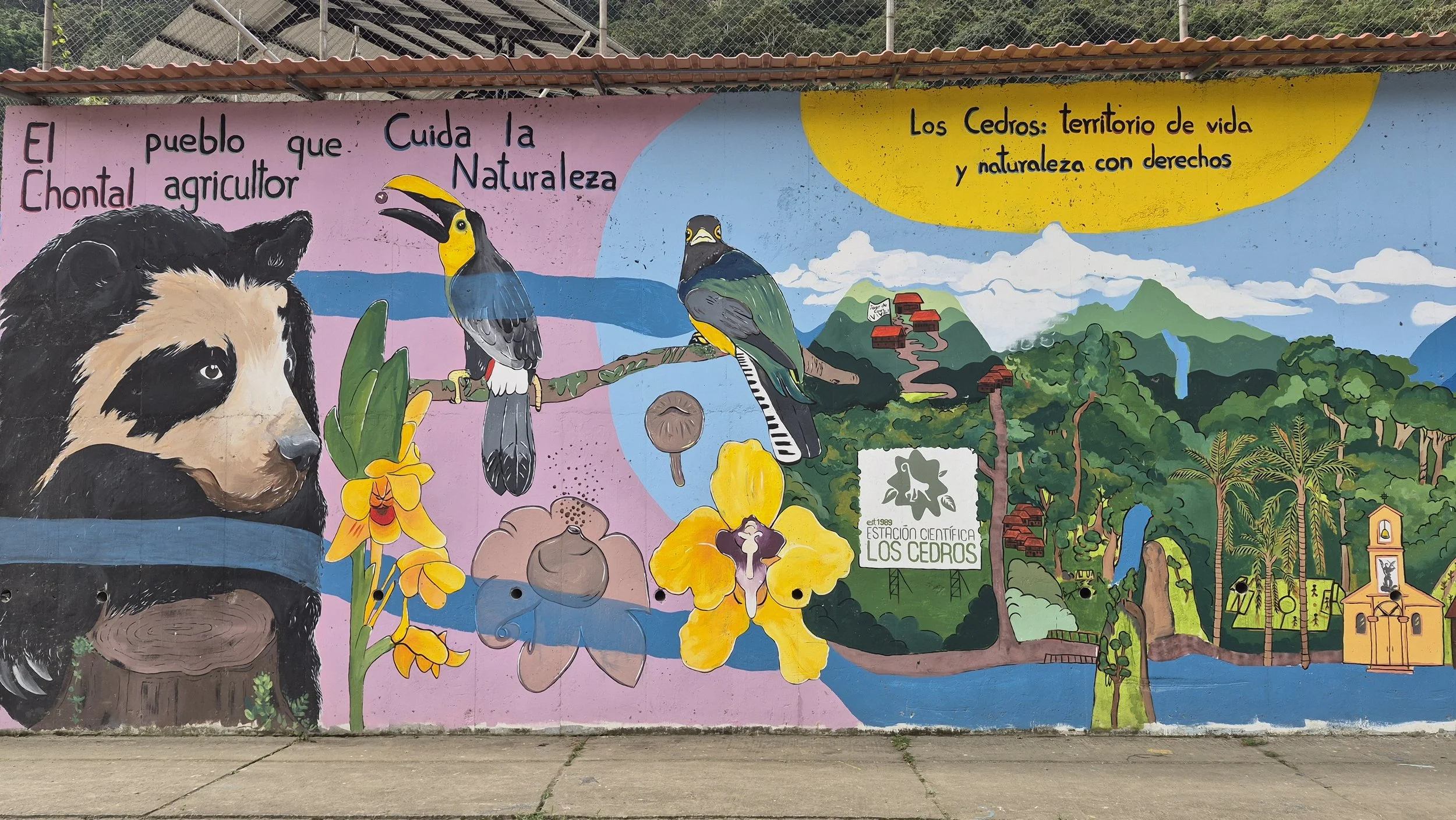
The new mural on the school outside wall: https://photos.app.goo.gl/1Shcaon5G5PDnYaS7
Masses, prayer, accompaniment
I met the new priest in the parish at the roof inauguration. He seemed like a nice enough person, and we had a good discussion about accepting people and culture first, and leavening with the Gospel. He doesn't seem to be on the machismo or the hyper conservative side, which is a tilting for this zone. But they say he's not around much, and he didn't invite me to anything, so I left it at that.
The church these days: https://photos.app.goo.gl/T1yRV394a6jwHBvv6
The plaque and commemoration: https://photos.app.goo.gl/JiXZ9PytPpQ1L6GM8
On Thursday evening was a Mass, and the communion song was one that really brought back my mother's presence for me, Pescador de Hombres. My mother and I sang this song together (in English) just days before she died, and since then, it's become a calling card of our new shared life and "mission" together, very much a connection to what my relationship with this community - and Ecuador - is centered on. So, it was a reminder and renewal of my mother's presence for me, and our closeness in this life. This too was a one of several events that really moved me and felt like a call to re-invest.
On Saturday, there was a month-mind Mass for Jose Rodriquez, father of Ines and of 9 other siblings, husband of Zoila, and brother of Rafael, the founder of Chontal. Most everyone in Chontal is related, and this is a big / special family. Jose and Zoila have lived behind the church in the same house for many years.
It was a gift for me to be there for the Mass, having missed the funeral. Ines has been in Aruba as a migrant worker, and couldn't come back for any of the services, so I recorded the Mass and sent it to her. The church was completely full, and Monica, a daughter, shared some beautiful words and invited everyone back to the house for food. So a few hours we all spent with the family, some of whom had come from great distances. One of the sons I know, Estuardo, had just recently been deported by ICE, and so I helped him get a little organized with the stipend he would receive.
After everything, the family decided to walk down to the cemetery to place the lápida tombstone on the bóveda, and Zoila asked me to accompany and lead a prayer when they were done placing the lápida. Caskets are slid into concrete cemented boxes and sealed with cement. Later, a thin tombstone, or lápida, is cemented to the front of the box with the deceased's details. So, we all walked down, and a few in the family put the cement together and placed the lápida, and I led a short prayer and finished with a short silence.
https://photos.app.goo.gl/bddnZBcyNiWdZHjZ9
While there in the cemetery, I felt again a sense of someday being buried there myself. It felt right, like something at home. I remember being a (very small) part of building that cemetery some 4 years earlier, and thinking the same thing at the time. I've been reflecting for the past 4 years now that if I die in Ecuador, I would want to be buried in that cemetery there.
On the way back from the cemetery, I walked with Zoila. She began to share about what she learned in her time caring for Jose. For almost a year and a half, Jose was non-responsive and bed-bound and required constant care. Before that, he had had Parkinson's onset, and dementia. When he was finally unresponsive and required total care, Zoila said, she really didn't want to do the caregiving. But, she said, she prayed with all her sincerity and asked God for the grace to accept it. That's all. And, she said, God gave the grace. From that moment on, she could accept it, though of course it was never easy. And she would want people to know that: if there's something for you to do and you don't want to do it, ask God for the grace to accept it, and He'll give it. As she told me the story, I noticed that in the whole day, among the mourning, she had a certain peace, resignation, confidence in her - even a glow. Like a moment of glory.
Visits
During the visit with the family, I sat next to Yolanda and got to talking. She is now separated from her husband, and living in a scant house in the pueblo. She doesn't really have a way to get income except for providing for some bus drivers that stay over in Chontal 5 nights a week. I noticed that Zoila gave her some extra food to take home as well - I believe it's been difficult for her with depression as well over the past few years. I know her husband too, and he was at the gathering as well, but I didn't have a chance to catch up with him. But in my last day or so there in Chontal, I was able to stop by her house and visit for a while. I left her with a little extra cash as well. I usually don't do that, and made that clear, too, but I couldn't *not* visit and help somehow after sitting with her and sharing a meal together and listening to her and her story.
On my first day in Chontal, I was invited to lunch the next day with Franklin and Mayra. They have 3 children, Melani, Carolina, and Isaac. The two girls are now in work and studies in Quito, while Isaac continues in 5th grade (and jellybean games, lol). They were one of the families principally affected by the Mother's Day landslides in 2014, before Isaac was born, where the landslide knocked down an exterior wall in the girls' bedroom onto their beds. Mayra found a way to scoot out of her room to get the girls out, and the family fled the house. One of about 7 or more families most affected, our fundraiser helped them to sustain themselves while they got back on their feet, and we became friends. I got to know the kids as well, and especially Carolina, who was involved in a pen pal for a while and who I taught some computer skills to, and who eventually took my pronunciation course in Chontal a few years ago. So, having lunch with the family, even though the girls weren't around, was a moving time of renewing the relationships and memories.
On Friday, I visited the Bosmediano Rodriguez family. Ines, whose father had recently passed away, is in Aruba, and I spent time talking with Luis her husband. He really misses her, and revealed a lot of personal things to me, including changes of heart about his choices and outlook on life. I felt once again how in the grace of accompaniment, people have a space to become vulnerable and experience a step in healing of grace. This also continued to be a theme for me in this time.
I had a chance to catch up more with their daughter Samantha, who I had been closer to when she was young, and now she's tending to the house while Ines is away, and she's aiming to become queen in the local zone. We talked about values and goals, and there are opportunities to collaborate in service of the community and in language activities that I'll be thinking about. She's grown up seeing her mother always in service of the church and community.
I also chatted briefly with Brandon their son, who I was also close to when he was little. I brought him a (American) football some years ago and that was his prized possession for some years. There are so many stories about him when he was little, including thinking my name was "Llorón", which is Crybaby, lol. Now he's in high school and it was nice to catch up for a short time. Scarlett, now in elementary school, we helped with her hip surgery recovery back in 2015 by donating a chunk of money to the raffle the family was having then. There are long histories with so many stories, that forge deep, cherished relationships, and this was really hitting home for me in this visit to Chontal.
Also on Friday, I visited Janeth Olivio, whose husband Arsenio is Luis's brother. Their family lost their house in the landslides of 2014 and our donations were a part of the help they received to rebuild a house. They escaped just before the landslides filled their house, making it alive within minutes. Their first three daughters are older: Tatiana, who was a leader of our youth group in the church for its short lifespan, has one daughter and is now with another guy living in Quito. Their other daughter Aracely is also with a guy, living in Aruba. Naomi is at home still finishing up high school with a year left. Their 8-yr-old daughter Rafaela was born with a variety of complex physical disabilities, and has needed medical attention throughout her life. We've raised money for them in our latest fundraisers, though I've given support since before the pandemic. Spending time with Janeth was catching up in person about her and her family. Once again, she opened up emotionally about her personal struggles, a continued theme on this visit to Ecuador. And a major theme opened up about her need for an advocate in her daughter's healthcare, someone help manage her daughter's healthcare planning. I started to make that a priority: to work with her to find advocacy and also financial support. I've been in contact with her since I came back from Ecuador, and she now has an appointment for Rafaela at Metropolitano hospital, which is considered the best hospital in Ecuador. It's also private, and it's expensive for them. So I'll be looking to see who wants to join together in offering them support in a fundraiser. I'll include all the updates about Rafaela's condition and the family's needs in that update.
On Sunday, I visited Fernando Ruiz and his wife Ximena Rodriguez. Friends since earliest times, Ximena is sister of Alicia, where I stay, and also Susana, Alicia's next-door neighbor and mother of Karen. They also were affected by the landslides on 2014, Fernando losing his carpenter workshop at the time. Fernando ferments his own "puntos", or "guanchaca", or "pájaro azúl, or however of the many words used for Ecuadorian whiskey fermented from sugar cane. A carpenter, he uses a small barrel of special wood, using a secret mixture of certain fruits and spices, to let the whiskey ferment for about a year. He shared some with me, which was amazing. Ximena is a teacher in a single-room school up in Magdalena Alto, and I've visited in the past. They were asking for me, and I'd have loved to visit, but there just wasn't time on this visit. We supported the school there a few Christmas's ago with Christmas decorations, and I'd love to see the kids, as it's always a joy to visit… Their daughter Katy was another child I was close to, who also was part of our youth group and also took my English pronunciation course a few years ago. She's now in college, has a boyfriend, and comes home sometimes. Valentina is still in middle school, so she's still living at home. Katy had come back for a visit, so I was able to meet again with the whole family, it was nice. I taught the girls a few card magic trick that they were excited to try out on their Dad! We looked at old pictures I had of the past, including the days of the landslides, for a nice trip down the memories.
On Monday, I visited Jimmy Bastidas, who was the partner of Maria Herrera, who died in 2022 from cancer. We had supported the family, and the kids are now grown as well. It was a short but meaningful visit, once again a long history and deep relationship.
At the end of my final eve in Chontal, I spent time next door at the store of Susana and her daughter Karen. Karen was another one of the kids I was close to, as she lived next to, and is part of, the family where I stay. Karen had financial limits that limited her college options, so she didn't go, but she's taking some preparatory classes in language to try again sometime. She's currently the secretary of community, which she doesn't enjoy. I supported her in seeing the whole experience as a learning time, it really is a unique opportunity for a 19 year old. She's also president of church, which she did volunteer for. So, we sat on the bench outside the store as the night was ending hanging out and laughing, I was doing magic tracks and I brought out the pictures and videos from the times of the past, the time of the landslides and other pictures, for her and her mother Susana. We were all laughing and amazed at the past and how time goes! And the night ended as Susana rolled down the grate on the store and we said our goodbyes with the lights turned off. The whole pueblo going to sleep. And it came to me really strongly how I had seen God do so much in these years, how my desires had been fulfilled, my vision validated, in spite of so many moments and stretches where I thought things were lost or over or pointless. I remembered a conversation with Susana in my very first times in Chontal, at that house with little Karen running around with her teasing, where I mentioned why I was there: not to bring something they didn't have, but because they already had a treasure, and I wanted to see it bloom.
And in so many profound ways, I have.
And to finish my time in Chontal, I left on August 4th, my mother's birthday, yet another remembrance of my mother's presence and our relationship here.
And that here is like family to me.
Odds n Ends
In the place I stay, I broke out with a nice batch of bed bug bites. I went to the medical clinic and got some antihistamine pills from the store that sells some medicine, and also changed beds in the room I was staying in. Those bites sure were plentiful and itchy though.
I had a minor medical procedure before arriving in Ecuador related to GI, and I had been on a very strict diet. I really fell off it in Chontal and got a little constipation at first, but that resolved and I didn't have problems, which is such a relief.
I had to get some laundry done before leaving, but the laundry machine wasn't working so well, so I went back to some of the old fashioned way with a bucket and still water and the laundry "stone", along with the hang-dry.
We lost internet also for a while, which isn't so uncommon. I poked around and reset the router and that resolved it. But the hosts believe that sometimes competing companies damage wires or signals to new vendors' equipment that provides the village, but I don't know if that's true.
Walking along one of the back streets in Chontal you will now find a turkey patrolling the street. There's a female on one of the properties, and the male goes parading around the street. I feel bad for him because he seems all puffed up, like in a stressed defensive mode. But kids walk by and touch and grab him, the poor guy. But he apparently isn't a threat for attacking.
More Loss
Within a week after leaving Chontal, I got news that the father of Alicia who I stay with, Rafael, who is also the founder of Chontal, had died. Alicia had gone to the city of Ibarra to visit him in the hospital while I was staying there. Rafael is also the brother of José Luís, who just had the month's mind Mass in Chontal. (They are also the brothers of Teresa, who is the mother of Rosa, who owns the Spanish School in Quito and who I stayed with on my arrival to Ecuador.) It was a sad finding out, although he was in a delicate state, it wasn't an overwhelming surprise. I wasn't able to visit Chontal again, though services were Ibarra, which was far too far by the time I found out. I sent messages, and had masses offered for him both in Ecuador and in the US. Rafael's daughters also include Ximena and Susana, who I've mentioned here, and about 9 children in total. Please remember Vicente Rafael Rodriguez Fuentes in your prayers. May he rest eternally in the room prepared for him by Christ in the Father's house.
It also then becomes a another inflection point in the life of the community. I believe that the school was the first property that was set aside by Rafael at the beginning for public use, and it started with one wooden classroom. To have another step of reinvestment in the school (the roof) at the time of his death, and to see the pueblo still going along and growing even after the landslides in 2014, speaks to the phases of life, and the genealogy involved. It gives me another special moment to reflect on the history and experience for me to be an agent of God's grace accompanying and leavening the life here.
Picture of Rafael: https://photos.app.goo.gl/Se1WyR1GUf8fcv4S6
To Mindo, then to PQ
I had planned initially to go straight from Chontal to Puerto Quito. Mindo isn't too far off the path there, and since I had the bed bug problem, I decided to return to Mindo to get some cream for treatment and to clean everything, and then go the next week to Puerto Quito, and that's what I did.
The day before I headed to Puerto Quito, I was sitting in my room in Mindo when everything started to wobbly and shift. I knew it was an earthquake. I waited to see if it grew, and after some early movement, it started to increase in motion. I was about to leave the room and head out when it started to calm. A lot of other people had left their rooms or homes. No damage happened to us, but everyone was checking out the news and talking about it. That was our experience of the 7.4 Colombia earthquake of August 10, in which over 300 people lost their lives sadly, may they rest in God's peace.
To get from Mindo to Puerto Quito, I would first need to get a taxi from Mindo to the bus terminal in Los Bancos, about 25 minutes. To do that, you have to wait at a certain spot until there are at least 3 passengers to split the fare. So, I'm waiting there and there are no taxis, but another person shows up, and then another 2 people with them, and a woman shows up with a baby. She was a take-charge woman, so we decided we'd get a taxi with a third person while the other 3 got their taxi and left. A pickup truck came up and she knew the driver, and I ran over to make sure he was going to Los Bancos. As we were getting in, the woman needed to fold up the baby carriage to stick in the cab of the truck. So she says, "Hold her," and give me the baby to hold while she did her magic folding up her carriage and then putting it in the cab. The baby was as calm as a cucumber, as were all of us, lol! It turns out there were two teen girls riding with us, so one of the girls held the baby. The mother was a hoot, and a funny, enjoyable ride to the bus station.
With the Sisters
I spent Feb 2013 to Feb 2014 in Puerto Quito, in my first major experience in Ecuador. I still treasure all the special memories and relationships of that time. And I became close friends in that time - even an honorary member! - of the Franciscan Missionaries of St. Joseph. So, I came back to visit them and Puerto Quito.
It was a really special experience to return again to praying, talking and catching up, and eating with the sisters, joining for a bit in the life and ministry. Anita from England, Rosemary from Kenya, and Yenny from Ecuador have been there for quite some years now, especially Yenny and Rosemary, who were there when I was living in PQ in 2013 (and before). Anita came a little later, and this time, she invited me to join in an online prayer experience she and Rosemary participate in each week. It was a nice experience, and a dip into the extensions of mission life.
She also showed me around the property where they're making a new, natural prayer garden. In our discussion we were glad to be in agreement: Natural and simple is the home of God, not the artificial and grandiose!
They have a dog RoYe, which is an amalgamation of Rosemary and Yenny, named before Anita arrived. He's a very friendly and engaging dog. I suggested they rename him RoYeNita, to add in Anita's name, I'm not sure if it stuck!
While there, I dug into helping them with their technology, which is a timeless tradition when I visit. Backing up computer files, Google Photos storage, installing a guitar tuning app, and helping evaluate a laptop, it all was part of a day's work!
We went to Mass each evening, and Fr. Martin Kelly, a retired St. James Society priest, celebrated the Masses. He hosted me in the parish house while I stayed in 2013, and integrated me into some of the parish life, including visiting some of the communities for celebrations of the Word. That was also a throwback memory to those special times. He gets out to the gym each day to stretch and walk. And he plans to be buried in Ecuador when the time comes.
After Mass each night, Fr. Martin and Estela, who I also remember from the parish back in those days, came over to the sisters' house to play Rummy with the sisters. They regularly play together, which is nice as a weekly recreational activity together. And I was able to catch up some with Martin.
I reminded him how, when I was just starting out in the parish house, I became discouraged and dejected because the language barrier was so strong. In the middle of one of my moods of wanting to give up, I remember him saying to me something like, "You don't see that you're growing, but you are." Just that little encouragement kept me in the path.
And I noticed something about me now: I see things differently than I did those years ago because I've enculturated with the years. I notice how I've grown in that enculturation and the language - I can much better understand and connect to the local people, not just with the people in ministry in the church. I can hear and understand everyone differently, and I feel more a part of the life in the pueblo. This was another thing that struck me in my time in Puerto Quito: noticing that I'm more connected to the local people.
Walking around, the pueblo seems more built up, more active. It would make sense, but it could also be my imagination after getting so used to Chontal and Mindo, which are smaller, slower places, especially Chontal.
Pics and videos around the pueblo: https://photos.app.goo.gl/Hp2r5Sqwe5889ytQ8
In the parish there's an adoration chapel that I visited. While there, someone came in to pray. It was a young woman who I had known in the parish, who's married with a few kids. She invited me over to the family, but I just didn't have the time. But it was good to see another recognized person. I had met some people in the Masses as well that were remembered from my stay those years earlier.
Walking along, I caught eyes with Fernando. Fernando has some mental and physical disabilities, and was / is a staple in the disability community in Puerto Quito. In 2013, I was volunteering for Amigos del Arca, a project for people with disabilities, where I got to know closely so many of the people with disabilities in PQ. Now, they have an activity center near the local hospital, which I visited just before the pandemic. Fernando has always been one of the leaders, looking out for the disabled community and organizing and advocating. So seeing Fernando was a special meeting, and we gave each other a hug. He works at the public bathrooms collecting the fees. Again, it was always hard to understand his speaking, but with my experience in Ecuador, now I could hear him more clearly. In any case, he said he always misses me and is asking about me, we had so many memories from those days. I was leaving shortly and didn't have time to visit the center, but we parted hoping we'd see each other again in the not so distant future.
Visit the Bazurtos
While walking through the pueblo, I passed by the shoe store of Maria Bazurto. The Bazurtos are a large family who all live together right on the edge of Puerto Quito. The grandmother, Rosa, lives with a few of her daughters (who all have substantial physical disabilities), and some grandchildren. I've written and shared much before about the Bazurtos, and I lived next door to them for about a month in 2015, through my connection with the Sisters. The Bazurtos live in real poverty, and their house, which was a marginal wood / board construction on concrete pylons, is now in shambles. The pylons have collapsed, and they're living on the earth underneath as much has shifted. The original construction was bare-bones and held so many of the family members. After the damage and wear and tear, it's really time for a new construction altogether.
After seeing Maria, she called ahead to the house that I'd visit, and later in the day, I took a mototaxi to their house. You can see the ride in the mototaxi in videos here.
I probably last visited about 4 years ago, I think. Rosa's son Mario was also there, and he has spent time working in a hotel on the coast, so of all the family members, he has more experience and connection with the outside world. He's working with a construction foreman to try to rebuild the house.
He took me on a tour and described their plans to first complete the floor, and then then outer walls along with keeping and updating the roof, and finally the interior walls. Also reconstruction of the bathroom. I'll include pictures / videos below, but I'm aiming to include these in a fundraiser.
Mario is looking to get a loan for $600 and then looking for $700 to get 2,000 cinder blocks. I've talked with Sr Yenny about collaborating (I only assist in collaboration with the Sisters), and I'm looking to see how the loan goes. Ideally, a donation would effectively piggyback on the loan amount. If they get a loan, it demonstrates their commitment to the effort and we become more a partner in community, rather than a provider. We've supported the Bazurtos in previous fundraising efforts, including their house pylons and medical assistance, each time through the Sisters. So there's history of things working out. I'll likely combine this fundraising effort with the support I'd be seeking for Rafaela's family in Chontal, and potentially for Zoe's family in Mindo. Though one has to be careful of what the support does to relationships.
I brought a large bottle of Coke as a gift, and the highlight of our time was talking about the past. As I mentioned before, with better language and enculturation, I can understand them better (they do talk fast, being from the coast!) and engage better. I took out the pictures from 2015 when I lived next door, with all of them, including some of the family that was no longer living there. The kids were little, like Jessica, Mercedes' daughter who was in a motorcycle accident around the pandemic time and we supported with a fundraiser. She's now a teen, and living in the house. We got a lot of laughs and amazement sharing these old photos. And the big hit was a video I had of the kids in the family cutting a rug one evening in the house next door where I was living. I had a Guasipichay, which is a house-warming party, and the Bazurtos came. They were pretty much silent for the whole party, but when everyone else left, they broke out the dance music and all the kids got dancing (prodded on by Maria). Watching the video, we laughed so hard we cried. It was so special to just have that short time with them, and I've already started following up on the house reconstruction while I'm here in Boston.
Pics and videos of the visit: https://photos.app.goo.gl/dNxu5PWUBrPBPsJD8
Climate
Puerto Quito is much hotter than Chontal. Mindo is the coolest, then Chontal, and Puerto Quito is a big step above that. It took me a day to adapt to the heat, especially after the first night. I used a fan in the room, but didn't have a mosquito net, but didn't get bitten. I took 2 satisfyingly cold showers a day!
On the Way Back from PQ
I had a nice good-bye with the sisters, and headed back by bus to stop in Los Bancos. I would need to get a taxi there back to Mindo, waiting again for a group of people, which did finally materialize after a half hour or so. But before that, I took the opportunity to go and check out the Mirador there at Los Bancos.
I've stopped by here at key times. I don't remember the first time, but maybe it was in 2013 or 2014? I also stopped by there on the way back from assisting delivering donations for the 2016 earthquake, and last year I made a stop there after getting blood work in Los Bancos. Last year I finally met the owner, Patricio Espinal, and we hit it off with great conversation. He gave me a copy of his book of the history of the zone (which I've wanted to read but have slacked on!). I did have a coffee again and enjoyed the amazing views again.
On my way out, I ran into Patricio and we had a good conversation. He said he's now writing a book of community perspectives, recruiting various contributors. I thought it was a great idea. I hope someday to read it (or at least put it on the list!)
In Mindo
In Mindo I picked up on the theme of mission, beginning again to walk into all the corners, through to the ends and pathways. There was a mixture of rain and sun, and the theme of rain caught my attention. I was out often getting into nature in the different directions along the routes out of the pueblo, beginning processing my visits to Chontal and Puerto Quito.
In that, I was able to get to some special spots to pray. There's one certain location that's been a special place of prayer for me for 13 years, hidden away along a trail, by a river. It's been developed a bit over the past 5 years, but still mostly unknown. There's a footbridge across the river, that goes to a place called The Invisible Monastery. I remember seeing this sign and this bridge several years ago, and it really summed up my spirituality. I suppose you could say it's Franciscan and Ignatian, but really Incarnational. And I see that the whole world is my house, and my monastery is an invisible one - anywhere that I find retreat and reflection. This is Franciscan, but it's also essentially Christ, who spent intimate time with his Father in natural places.
Some places of prayer in Mindo: https://photos.app.goo.gl/TTG7KKD4pYAhwVfZA
In prayer time, the story of Elijah came up often. Elijah goes out to meet God in the wilderness isolation, discouraged and depressed, with complaints of being lonely in his mission. He isolates in a cave, and God invites him to come out to be in His presence. Elijah senses the wind, the earthquake, and the fire, but he doesn't come out. Only when the ash falls, does he come out to encounter God. And that's what it means to be a legitimate prophet: to know where God's voice and presence is encounterable. Only in the silence of falling ash. And that's where I looked to be in a time of prayer each day.
Mission can be presented like rain. A going into the world of the other, in the valley, a seeping into everywhere, carrying with me the Gospel inside. It's enculturating, entering all of the life and culture, meanwhile proclaiming relation with the Gospel from within, from that place of integration and enculturation. And allowing, nurturing, and following the sprouting that comes from that union.
As usual, I spend time visiting various people in the pueblo and spending time with folks like the artisans. There is a person leading social services, called Mindo Solidario, that assists people. I didn't have the time to make connection with him this time, but hopefully in another visit. It would be good to make more contact with people who are struggling most. Unfortunately, there isn't collaboration between the church and Mindo Solidario, and the church doesn't provide a bridge to be in contact with people more in need. There is also a person leading up a support group for people with disabilities, Norma, who I hope to catch up more with on another visit, but just ran out of time on this one.
The church hasn't changed much, but become a little more "regular", in that the same people are doing things over and over. Once again is the loss of the role of ministry: to serve others into blossoming. A sign that there is health would be that there is variety in doing the roles, as they don't require all that much specialized skill. But this is common in parishes: favorites possess their roles, and others gradually drift away. It reminds me of the correction that God gives to the "sheep" of Israel when he's promising to replace the shepherds with one, His own:
Therefore thus says the Lord God: Now I will judge between the fat and the lean. Because you push with flank and shoulder, and butt all the weak sheep with your horns until you drive them off, I will save my flock so they can no longer be plundered; I will judge between one sheep and another. (Ez 34:20-22)
There was an event of the movement Juan XXIII, which is a charismatic conversion-based movement very popular in Ecuador. Back in 2014, I lived outside Santo Domingo with the pastoral leader of that movement. It's similar to Cursillo, which did here in the US back in 2004. In theory, there is a wonderful design to retreats like these, and there are some real special graces that do come about. However, I'm not a big fan of how it's practiced for Juan XXIII in Ecuador (I don't know about other places). They set themselves apart with brand clothing, special customs and sayings, and their meetings apart. It creates a sense of belonging that, I believe, supersedes the baptismal grace and basic communal identity. Well, one weekend a large group came scaring everyone with an outside-to-inside proclamation, which I believe is different from the Incarnation. Unfortunately, vulnerable people can be taken advantage of. Mission, as you see in this post, begins with the gentleness of rain, seeping into the earth, giving new life. Not with loud thunderous proclamations that step on.
Back in the hotel, the kids Camila and Liam are taking kickboxing classes. I tell you, it was a permanent, non-stop laugh the whole class watching Liam go at it in the practices. He's one of the youngest in the class, so some things are a stretch for him. But he loves to do it!
The expressions they use in kickboxing are:
frongkey, sighkey, rounkey, jak, áwepair, cross.
They all sound weird, but those are my best spelling of the sounds they make. The real words are Spanish transliterations of words you do know:
front kick, side kick, round kick, jab, upper (uppercut), cross (cross punch)
At times in the hotel, I invite Liam to go at it using these words, and he ULOADS on me, lol, it's sooo funny.
Last days
I spent my last days in Mindo meeting with a lot of people.
First, the artisans. Pamela from Peru is a long-time friend, who currently lives in a makeshift dwelling with her two children. We caught up, and I bought some chocolate from her made by the Invisible Monastery (I still have yet to know what it really is.) And we dais our goodbyes.
I bought some items from Jorge from Venezuela and Alejandra from Colombia, and we got a picture together as we said goodbyes. Most days I stopped by to visit them on my way around the pueblo - their store is right nearby. Jorge gave me a heartfelt thank you for the English help - we have often done a lot in language and culture sharing over the years! And a goodbye to Jairo, an Ecuadorian who owns a handmade wooden kitchenware shop next to them.
I made a special visit to Casa de Piedra, a hotel I used to stay at a lot when in Mindo, back when I wasn't renting for long periods. It's a beautiful place, but I can't afford a monthly rent there. But the owners and relatives have been friends for a long time now, and I stopped by to say goodbye. Mariela is the sole owner since her brother Henry died a few years ago, a tragedy as I knew him well. Sara from Colombia, who has become like family to them, I got to say goodbye to, as well as her son and daughter who happened to both be around. Now all grown up, I remember when they were kids!
I went by my old friend Antonio's house, which is now rented to a young man named Jhordy. But no one was home. Both had done my Tree of Life workshop back in 2020. It would have been great to catch up with Jhordy after these years.
I've developed relationships with several of the indigenous vendors from Otavalo, who are all related. I bought some things from each family, to bring back for myself and others. I had the chance to say goodbye to Luis and his family at the store, and after Mass, I shared a heartfelt goodbye with his brother Luis. Luis and his wife have a daughter in Yonkers, NY, and they have to visit each year to keep their visas alive. Another relative, a young man named Enrique, has another shop and I bought a rain coat there. He now has a newborn that he keeps in a carriage in the store.
A ran into Edison, a local carpenter, in the street. He invited me to come by, but I was leaving. A few years ago, we crossed paths in the street after meeting once (I was looking for a quote on a desk), and he ended up pouring his heart out to me in confidence. The next time I visit, I hope to stop by his shop.
I met a local resident Juan some years ago when he was working on Antonio's house. He now works streetcleaning, and every time we see each other, we call out, "Mashi!", which is "friend" in Kichwa. Neither of us speak Kichwa, but it's our greeting tag that makes us both laugh, lol!
I also met with Tatiana and Greg, and Ecuadorian and Canadian couple. I met Tatiana several years ago as she handed off to me an English conversation group in Mindo. She later came back to Catholic Mass, and I'd see her in the church sometimes, and she and her husband invited me out to a coffee. We had a good conversation, just before I was to go. One focus was the value in everyone's stories and testimonies, and another related to that was accepting one's self and desires as the guide to vocation.
At the last Mass there in Mindo, I had it offered for the founder of Chontal, Vicente Rafael Rodriguez Fuentes, making a donation. After Mass, I said goodbye to everyone I knew there. The week before, I met up with a senior Mindeño, Oswaldo, who I've known and had chats with over several years. The last time I stayed in Mindo a long stretch, I had wanted to interview him about his life and history of Mindo. Earlier in this visit, he pulled me aside and asked for financial assistance with his travel to and from his medical appointments in Quito. (They are usually very early, meaning people who live far away need to stay overnight somewhere to make appointments.) I only give in collaboration of community, and told him so. So, after a week or so, I did have a little bit of money to give him, explaining to him I'm only making this one exception and not expect it. :). I really can't be giving to individuals outside of a community dimension, as that breaks down relationships, generally speaking. But I made this exception. I invited him to the interview again and he agreed. But I didn't see him at the last Mass. Hopefully, that interview can happen next time I visit, if he's still alive.
The local priest asked for a private conversation after the last Mass, and the next day I stopped by. Without sharing details, he confided a deeply personal reality to me, feeling me to be the only person who could understand. I shared what I thought was appropriate and gave him support. I won't say any more, but that the common theme of what I offer being a gift: people trust to completely open up to me, and God works through that. Being like a priest, like a religious, but outside of the institutions and all their connections, gives people a confidence in confidentiality and freedom.
There of course were also goodbyes in the hotel. They told me it was their mother's birthday, so I came to dinner with a nice shirt and everything. It wasn't, it was my despedida. I was surprised and of course grateful to them. We all ate a good meal, a special cake for desert, and a quick shot of the guachaca. I ended up gifting my playing cards that I do magic tricks with to Camila - I think she'll treasure them.
I gave away a tablet stand for the family (feedback said it was the best gift!), for Zoe a seat cushion, sitz bath, and the Miralax I had leftover. Marcelo got a phone battery stand, and Isidro and the family got extra tips and money.
And the next day, I packed up, said final goodbyes, dragged by belongings to the bus station, and got on the after-lunch bus to Quito.
A few of the last pics in Mindo: https://photos.app.goo.gl/wXehuamD2wHRgoYh7
Quito and Travel
Since Rosa was out of the country, there wasn't an opportunity to pass through her place and say goodbye and stay a night. Instead, I went to the same hostal I've often gone to in transition because of its prime location for me. Near the bus station and the shopping center, it's only $15 a night - and it shows, lol. While eating breakfast the next day at a local restaurant, I was able to finally catch up with Antonio from Mindo, who lives in London. He's coming in December, and I've thought of returning then, too.
I scheduled an Uber to the airport, and it was a good ride with conversation. The driver was sharing about his first daughter's quinceañera party, which she chose as a small beach outing instead of the full-blown, wedding style that's popular. Good news to his ears, as gas prices have doubled since the president eliminated the gasoline subsidy. Foreboding of the problems that continue, and future higher prices all around.
A view of Cotopaxi from the airport: https://photos.app.goo.gl/vrnd1aVWt9wQCRcy9
In Boston
It's been a little difficult settling back in in Boston. As maybe you can tell, there was a lot to digest in this experience, most especially in Chontal, and also in what everything reveals about my own vocation and future.
I was able to visit the Ecuadorian community in Lawrence, MA and participate in the novena and fiesta of the Virgen del Cisne. I've been participating most years since 2016 when it really was launched. This time, I made the last 2 novena nights, where I was invited to preach. That's always a deeply meaningful, gratifying, and connecting experience. Different families host each night, and there's prayer, preaching, announcements, food, and social (some bingo for fundraising as well). When preaching, I integrate real stories from my time in Ecuador, to people who mostly can't return.
To get home after the novenas, I get a ride to the local train station at 10pm. It's an hour ride into Boston, and there I get another train for another half an hour to the end of that line. From there, I wait for a bus for a 10-minute ride, followed by another 10-minute uphill walk. It's about 2 hours to get to the events in Lawrence, and 2 hours back. So it's a long day, but a blessed one.
Here are a bunch of pics and videos from the novena and especially the fiesta: https://photos.app.goo.gl/moTBVe1z1j5SrVQ99
At the end of the fiesta, a young man gave me a ride to the train station. We arrived early, and he also opened up and confided in me. Once again, I listened and gave him support. I've known him for some years now, and life hasn't been easy. But God gives grace all for the good of everyone.
I've already been in touch with the Bazurtos and with Janeth, and I starting the fundraiser is on the list of things to do!
My job in East Boston has started again, and this time with a bang - the key staff member who was much valued and really kept everything going, suddenly is no longer there. There was a tension with the director, and things blew up. The place has always had crossover with the mission of Barriers to Bridges, but is certainly part of the system that causes friction with my vocation. Everyone's in shock and hurt and saddened, and I've accepted to step up more roles just for two months.
This gets to my future. While there, I had sensed a call to return in Ecuador, and even be there at the end of my life. And this puts me in conflict with not only holding work, but the changing laws to public health insurance and work requirements brought about by the current US government. It could make it practically impossible for me to go back and forth between Boston and Ecuador. I'll have more to write about those tensions soon. Since 2016, the winds have blown against the mission of Barriers to Bridges as a black-and-white, divisive, war-based environment has been unearthed in human hearts and validated. It has been a bridges-to-barriers environment. Just like Herod comes for the Child, just as my mission was being born, a threat loomed. And just like it finally gets Jesus in the end, there might be that threat now. My first desire is to spend time in both locations. Second would be to live and stay in Ecuador. Last is to live and stay in the US. And currently all options are becoming extremely challenging to continue in the spirit of Barriers to Bridges. These are crisis times, and I'm not exempt. And yet, the Gospel is always wanting to be reproduced. God brings down and raises up again. And despite the natural anxiety and pain, I trust that God's life in me never dies, and resurrection always follows death.
ONGOING MINISTRIES & PROJECTS
INTERNATIONAL / INTERCULTURAL (ECUADOR - BOSTON )
Into the Waters: An International Immersion Visit & Retreat
LISTENING/LEARNING
ALM: Spiritual Reflections Blog and Books
Spiritual Reflection Learning Videos:
SPIRITUAL REFLECTION WORKSHOPS
Health
My health in my time in Ecuador was excellent! July became the first time in a year and a half that I was pain and sickness free (well, my hip always hurts at least a little). The procedure I had before I left for my digestive tract issue worked great, and I didn't feel any heart stress. I'm a little deconditioned, but stronger than I was in the spring getting over the long fever (and winter), and I extended more in Ecuador. It was a good feeling.
I had some minor bug issues, including the bedbugs in Chontal. Lots of no-see-um bites and some mosquitoes too. Plus a minor bee sting. But nothing big or serious. I broke my diet plans, as I was traveling and also started to just eat with the family. I started caffeine again, 2 - 3 cups a day. In the meantime, I identified ingredients to make more heart-healthy meals next time. Instant pot-type cookers and airfryers are $150-200 or $120-150, respectively, so that's good to know. Since coming back to Boston, I've gotten back to the better, healthier diet.
Financials
There are no significant changes in the B2B financial situation, except that it’s been dormant. The school in Boston and other commitments are keeping me busy for the next two months, but I should have more availability outside of school. I’m hoping to offer more the pronunciation course and spiritual/vocation workshops, along with communion growing.
Click here to see the Financials.
Other Stuff
I hope to have more photos of odds and ends to share in an upcoming update!
Reflections & Vision
On the plane ride from Ecuador, I started gathering up some summaries of my experiences. And somethings gradaully became visible. I could see this:
“The Spirit of the Lord is upon me,
because he has anointed me
to bring glad tidings to the poor.
He has sent me to proclaim liberty to captives
and recovery of sight to the blind,
to let the oppressed go free,
and to proclaim a year acceptable to the Lord.” (Lk 4:18-19)
I looked across my notes as I gathered things and noticed patterns
I listened to people in their most vulnerable times, for their hearts to be relieved, validated, freed and lifted up with hope.
I had experienced the blessing of seeing the fruits of planted, incarnate love in Chontal’s own, hope-filled, community-centered reinvestment in their school, against the prevailing winds, that came in part through my own presence over the years.
I saw that what I openly expressed many years about what I had come to do, was happening.
Was in service in a variety of human ways to people who were poor, immigrants, indigenous, rural, and artisans/artists, in service in a number of ways, and still receiving so much more in return.
Thus says the LORD:
Just as from the heavens
the rain and snow come down
and do not return there
till they have watered the earth,
making it fertile and fruitful,
giving seed to the one who sows
and bread to the one who eats,
so shall my word be
that goes forth from my mouth;
my word shall not return to me void,
but shall do my will,
achieving the end for which I sent it. (Is 55:11)
I could see God with me and through me, and remembered those moments of closeness to Him. We did it together, by Him and His grace, the fulfillment of the scripture. There are no words for the peace and satisfaction of a life with God, as it will continue forever.
And I felt more than ever confirmed in this way, this mission, after struggling with doubts from not seeing what I hoped “results” would be.
A Table Will Be Set
In July, I was in Chontal for a special event at the local school. It was a long time coming.
My first times at the school included going there back in 2011 and 2012 for very brief visits. When I returned in 2013 for a longer visit, I went up to the principal of the school and we talked briefly about language like English. We agreed I'd check back in at some point.
Fast forward a year, and I was present in the community during the tragic, traumatic landslides that affected the whole village. That started a fundraiser to help people re-build homes and their community. It also meant it was time for me to spend more time in Chontal, for it to be the center of my "mission", as was the plan all along.
I returned around Christmas time for the first time to stay for a long time. I brought a Santa outfit, and also a bunch of Christmas supplies. They came in great handy for the school, which didn’t have any supplies for the Christmas celebration. The Santa outfit and the fake snow were a big hit, and a lift to the whole school.
And one thing always stood out to me.
The schoolyard had no roof. The hot sun and the pouring rains - and the puddles they left behind - made the schoolyard a torture for the kids. A lot stayed around the classrooms and avoided it. Those that jumped in came back soaked, dirty, or just cooked from the sun. They need a roof, I always thought.
Wel, there was a great connection with the school staff and the community, and when I returned the next year, I again brought the goods for Christmas. It was a sad moment, too: 4 children - all related - had died by suicide within the previous several months. Bringing a healing element into the school, I joined with the teachers in giving the students a chance to grieve and let go. I found a way to start a youth group for the local kids, which took off. Later, I was asked to help with rebuilding the dwelling in the school property for a teacher. The teachers are usually from cities, and spend the week in the village and return on weekends to their homes. The school has a little dwelling for one of the them to live in, and the roof was rotting. A friend helped with some funding for the cinder blocks to redo the room. I helped the staff with their technology, and brought along a projector to donate to use in classrooms. Finally, I talked with the principal about starting exploratory conversations with another school in Massachusetts, to see If there was interest on both sides to form a connection of some sort. But there was still no roof.
By the time I was ready to return to the US, the school was shifting. It was being absorbed into bigger school in the next-door town. There was now a new principal, Pedro, now a coordinator below the principal in the neighboring school, said he was open to continue the discussion that had started about the school connection.
Back in the US, I found a local school that was interested in - and had experience in - making a connection with the school in Chontal. I made contact with Pedro in Chontal, and we set up an online meeting with both schools to talk. But Pedro didn't show up, leaving the principal and Spanish teacher from the other school, and me, all hanging. He sent a message that he had to run an errand to the neighboring school. He agreed to schedule a week later. The next meeting, he didn't show up either. He never responded. The other school removed their interest, though they expressed interest if another school were found. I sent a notice to the Chontal parents' committee explaining what happened, and that I didn't have confidence in Pedro.
When I returned later in the year 2016, there was a big shift. The school was now fully part of the bigger school. There were signs it was being treated as second-class. It lost its original name. It received secondary attention. There was talk of closing it. There was contention between the staff and the local community, unlike before. It was like the school was being swallowed up and broken apart. But the community of Chontal obviously didn't want the school to close.
Suddenly, anyone related to the church wasn't allowed in the school anymore - no more religious activities that had been the custom. The abruptness left the community and church scrambling, and the kids confused.
And I found something strange when I tried to visit. Instead of the kids calling my name and storming me, I was locked out. I was treated like a stranger and outsider. Only two teachers were left over. It seemed deliberate. I got talked about and laughed at behind my back. It was painful.
I've known Agnes and her family since my first days in Chontal. When I started arriving after the landslides, she was the president of the church. We worked together on so many church activities, it's hard to recall. We helped her family during tough financial times, and she was a principal recipient of the graces of retreats. I always told her, "I am always ready to join with the community and support the community, but only when it’s the community." She butted heads with the school during that time. But by 2024 or so, she was the president of the whole community of Chontal.
In February of 2025, I received a message from her that the community had decided on several financial supports. One was to have a program for a local family in need, and another was to build a roof at the school. These were two dreams I had always had. I said, "I'm in!" And I started a fundraiser in the US.
So, the parents' committee got $30 from each family in Chontal with children in the school. A supplier was found to provide materials with that money. Expert laborers were identified - our fundraiser would pay for them. And the supporting labor would be provided from mingas - mandatory community work days - that include the whole village. The school administration was not included.
After a lot of delays, the roof was finished earlier this year. As another investment and a vote of importance and confidence, it keeps the validity of the school up front, through the will of the community, in spite of the administrative pressures.
The community wanted to have the inauguration when I could be present, and we arranged a date. The community had the school host the event, with the teachers and students present. So I arrived glad to see a lot of people I was just catching up with after a long time.
So I'm walking around and greeting and catching up with people, and they announce my name, and I wave from the back, and then go back to catching up with so many people I haven't seen in so long and want to say so many things to. And then, I feel a tug on my arm and I turn around, and the school coordinator tells me I'm supposed to go and sit at the head table. I looked over and there were other people involved in the builders and materials who were announced, too, sitting there, and I got the idea. I had no idea I was going to be at a head table.
And then, after the priest and queen and new community president were introduced, I was surprised when they invited me up to speak some words. Not a big deal for me, as I always have something to say! I get thanked by the school principal, by the community president, by another community leader who has good words to say about the long relationship I've had with the community. And they presented me with an appreciation award plaque.
And then, the music started, and a big plate of food was placed in front of me: the celebratory pig is roasted. It was an overflow of appreciation.
And all along, in the very front row right in front of me and the head table, were the teachers and administrators of the school. And a familiar face. Pedro had come back to visit.
They had to sit there and watch it all.
You set a table before me
in front of my enemies;
You anoint my head with oil;
my cup overflows. (Ps 23:5)
All the years of pain from exclusion and watching them devalue the community that I loved, and feeling powerless to do anything about it. All the years of a broken lost dream. Of people questioning and minimizing what I'm doing. All the years of hanging on by the thread of the hope of the cross.
God's time and way is hard for us to understand. We want immediate results. But love goes beyond our horizon of timeline. It keeps us walking in the presence of frustration, exclusion, opposition, pain, listening and following all the way through the dangerous valley, because someone is that important to us.
And the cross and resurrection gives us hope.
That finally, at some point, a table will be set.
And the dream will be realized.
The Lord is my shepherd;
there is nothing I lack.
In green pastures he makes me lie down;
to still waters he leads me;
he restores my soul.
He guides me along right paths
for the sake of his name.
Even though I walk through the valley of the shadow of death,
I will fear no evil, for you are with me;
your rod and your staff comfort me.
You set a table before me
in front of my enemies;
You anoint my head with oil;
my cup overflows.
Indeed, goodness and mercy[e] will pursue me
all the days of my life;
I will dwell in the house of the Lord
for endless days.
(Ps 23)
God Will See Things Through
Around the time that I first started spending time on my own in Chontal back around 2013 or 2014, I was staying in a house owned by one of the active church leaders. Next door was relatives, including Daniel and Susana and their daughter Karen, who was probably around 6 at the time. Susana invited me over for a breakfast, and so I went.
We ate and talked, and near the end, she asked me about what teaching I was going to give to the households I visit, as a missionary. She gave a few examples that she was familiar with and probably looked forward to: "Tell the men not to drink, the woman not to be lazy, and the children to obey their parents?"
I smiled and said, "When I accept your invitation to breakfast and enjoy the food and listen to you, that's a teaching. When you offer me another glass of orange juice and I happily say 'Yes', that's a teaching. When I enjoy playing with your children, that's a teaching." And I continued, "I didn't come here to give you something. I came here because you already have a treasure.
And I want to see it bloom."
Last week, I was in Chontal. The whole visit was a tremendous gift and grace, so much happened in re-connecting. The depth of the relationship came back, in so many ways. I got to accompany and pray with a big central family over the loss of their dad, a brother of the founder of the community. I got to see a new roof over the schoolyard, and catch up with and renew so many relationships. Us older folks are older, while there's a new generation of little kids. And the kids have grown up. So on Tuesday morning, I had to get a bus at 7am. And Monday evening, I found myself back at Susana's place, sitting on the bench outside their little store there, and talking to Karen.
From the beginning Karen was always around, with her mischief and meddling laugh. Never afraid of a trick, she also had no hesitation in correcting my young Spanish, teaching me words and how to pronounce them. We reviewed my real-time videos of the rains and landslides from 2014, where you could here her voice advising me where I could go and film them, and you could see her playful face-making. When I arrived around Christmas that year with a surprise Santa outfit or the school Christmas program, I asked Karen a day before if she thought Santa might come this year. A sadness came over her face as she replied, "Santa never comes here." Karen was one the founding members of the youth group in 2016, and I remember her happiness and excitement just to have a group. Always active in the church activities, she always played a role in the dramatizations. Later Karen was one of the youth who joined to help me in 2019 in the village Christmas program, assisting Santa with the gift-giving. She was a frequent visitor at the her aunt's house next door where I stay at, and joined in our pandemic exercises. She had difficulty getting into a college at a time after the pandemic, and so she's living at home while taking courses online.
And today, she's the secretary of the community council.
And she's president of the church.
And we looked at videos and pictures and laughed and remembered.
And it got to be 9pm, which is bedtime for Chontal. Her mother Susana caught some of the pictures and videos. And then, she lowered the grating, turned out the light, as it was the end of the night.
We said our good-byes for now, how great it was to see them, and there would be new possibilities - I hope to come back with more time to spend, soon.
But now, it was time to go.
And I couldn't help but think of that visit 12 years earlier.
I had come back full circle.
And those words:
"I didn't come here to give you something. I came here because you already have a treasure. And I want to see it bloom."
"I came so that they might have life and have it more abundantly." (Jn 10:10)
I got to see it.
In the beginning, God is here. And though it may not always be clear or visible, all along the way, God is here.
And in the end, He is here, too.
To see things through.
“Behold, I am coming soon. I bring with me the recompense I will give to each according to his deeds. I am the Alpha and the Omega, the first and the last, the beginning and the end.” (Rev 22:12-13)
The Cost to Be With Us
On this visit to Chontal, I had the wonderful gift of being able to accompany people in some special times, and renew the relationship we've had for years.
I was able to accompany the Rodriguez Villareal family as they celebrated the month's Mass of their husband, father, uncle, grandfather, a large family in the village and a man who was one of the original people in Chontal. Recording the Mass for Agnes, who is out of the country, and spending time with the family afterwards in their hosted gathering. Catching up with all 9 of the sons and daughters who I've known for so long, and helping one with their recent deportation. Finally, accompanying the family as they brought their headstone to the cemetery, and leading the prayer. Afterwards, to listen to and validate the stories from his wife, who cared for him for several years, including the last year where he was non-responsive.
I was able to visit with a family with a daughter with disabilities who has needed years of on-going care, to talk about next steps and strategy, and offer support and help to find more.
I was able to be at the inauguration of the new schoolyard roof, a dream in the making for years, that we helped to fund, and that will give protection from the elements for the kids in their activities.
I was able to spend time with the next generation of kids, doing games and language, a big lift.
I was able to visit and re-connect with so many people, share the memories like a family member come home, seep into the community like water into soil again, and see results budding forth from so many years prior.
And when I came away after a week, I brought something with me:
Bed bug bites on my body. Gnat bites all over my hand.
That's part of the cost just to be there with the people.
Now, going back, there's more. Lost work opportunities, loss of finances and financial security. Losing healthy food and exercise habits within the local life. The torture of learning a new language and culture! And, the loss of many friends of old who could no longer relate to my journey. The loneliness that accompanies it.
The cost is very high.
And that's just to be here, with the people.
When Jesus is on the cross, we are seeing not only what he had to do to die. We are seeing the price he paid to *live* with us, just to become human with us in this life. And after that, in death.
And in the moment that Jesus is on the cross, he hears the voices.
"Save yourself by coming down from the cross." (Mk 15:30)
That would mean he couldn't be with us.
I don't think it ever crossed Jesus' mind.
I hear voices.
"Why do you go there?" "You need to give that up." "Come back to the States, get some good work for yourself, and then retire in Ecuador." "You could help people more back in the US."
To come down from the cross.
But I wouldn't dream of it.
Because I want to be with them.
I was his delight day by day,
playing before him all the while,
Playing over the whole of his earth,
having my delight with human beings.
(Prov 8:30-31)
Live With Our Mother
I was sharing some of my theological thoughts recently, and something came up. It seems that saints had previously thought and written the same things. Whenever I go looking about my spirituality and theology I find that out: another saint already had the same approach.
Whenever Popes write encyclicals, a lot of people in the church read them. I have a confession: I don't. I used to. And then I found that pope encyclicals laid and presented what I was already thinking. I don't have to "obey" it. I already recognize it. It's already in me, too.
So, how is it that someone who left the seminary after a short time with so much potential, and who never formally studied theology, has all this spiritual and theological insight of popes and famous saints?
When Jesus was twelve years old, he found himself with his family from the rural area of Galilee at the Passover feast in the big glitzy city of Jerusalem. And an amazing thing happened. He impressed all the religious experts who are in charge of religion. Maybe he got an invitation to join up, it doesn't say. But what it does say is that he didn't.
He went to Nazareth and learned from his mother and father.
In the life of the small rural village where she lives.
When I left the priesthood seminary in 2012, I had a lot of potential. That was the big word. One religious community thought I was their hope. I had the best grades, got along with everyone, took initiative, had a gift for pastoral wisdom. But I didn't quite fit into the big religious system.
I left.
And I went to rural Ecuador, where I believed was the presence of my mother, through a donated church in her memory.
And there I grew.
Not taught by a formation program.
But by grace. Living with my mother, with the people.
Some years later, while my classmates were getting vested with chasubles in the great cathedral in Boston, I was being vested with a poncho in a remote indigenous community in Ecuador.
That's why I don't need to read, analyze, study, debate the encyclicals, as if it's something outside of me I need to take in or adapt myself to.
Why I already understand them. Why they're already inside me.
The most important steps to take with God isn't to get religious education. It's not to be in the churches and with the clergy and habited religious people. In the institutions.
The most important step is to follow grace and love of the Gospel.
Down the mountain, outside the common, to live with "inconsequential" people. Be little with little ones.
To live with and learn from our mother.
And you'll know what the saints know.
Because you'll know who they know.
At that time Jesus said in reply, "I give praise to you, Father, Lord of heaven and earth, for although you have hidden these things from the wise and the learned you have revealed them to the childlike. Yes, Father, such has been your gracious will. All things have been handed over to me by my Father. No one knows the Son except the Father, and no one knows the Father except the Son and anyone to whom the Son wishes to reveal him." (Mt 11:25-27)
“Come, follow me.”
-Mt 4:19

Closing
Feel free to comment or reach out anytime.
I'll post again when it's time.
May God bless us all,
Jerome